
6
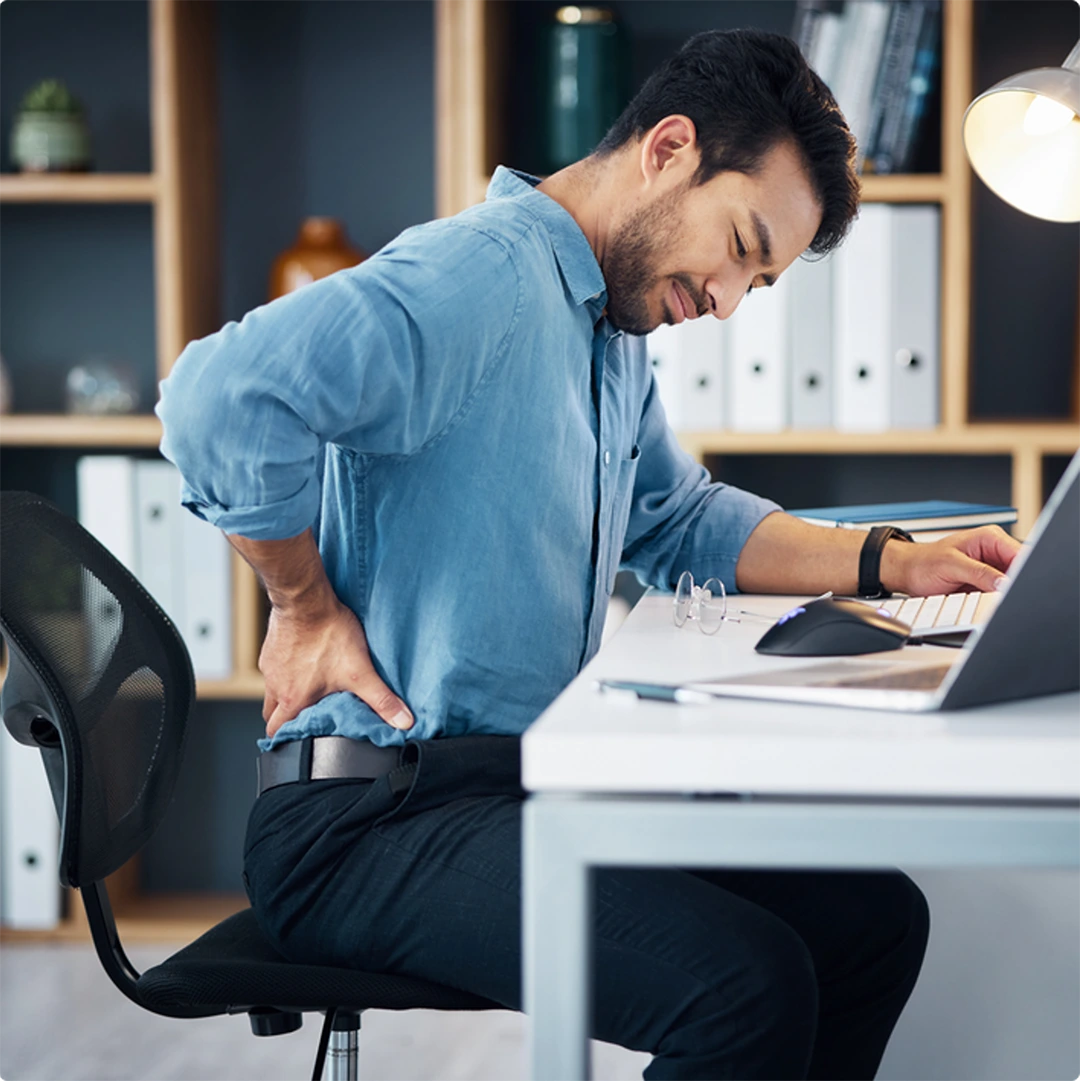
Around mid-afternoon, it usually starts as a dull, irritating ache deep in the glute. By four o’clock, that ache transforms into a hot, shooting sensation traveling down the back of your thigh, perhaps buzzing into your calf or turning into pins and needles in your foot. Anyone who has tried to survive an eight-hour shift while nursing sciatic nerve pain knows how excruciating stationary desk work can become. When your job demands hours seated in front of dual monitors, simply getting through a team meeting can feel like an endurance test.
The instinct is often to grit your teeth until five o’clock and collapse on the couch at home. Unfortunately, prolonged sitting is precisely what feeds the flame. The human spine was designed for continuous, dynamic movement, not static compression. By understanding what happens mechanically when you sit, and by integrating targeted, discreet stretches directly into your workday, you can decompress the nerve, calm irritation, and reclaim your workday focus.
The Biomechanics of Desk-Bound Sciatic Irritation
The sciatic nerve is the longest and thickest nerve in the human body, originating from several nerve roots in the lower lumbar spine and sacrum before weaving through the pelvis and traveling all the way down each leg. Because it threads through dense muscular territory, it is extraordinarily sensitive to external pressure and postural imbalances.
When you sit in a typical office chair, two primary structural problems occur:
-
Direct Mechanical Compression: Your pelvis tilts backward into a posterior slump, flattening the natural inward curve of your lower back. This posture shifts your body weight directly onto the sacrum and the piriformis muscle, a small stabilizer deep in your buttocks. The sciatic nerve runs directly beneath—and in roughly ten to fifteen percent of people, straight through—this muscle. Hours of body weight pressing against a firm seat pan effectively pin the nerve against bone.
-
Reciprocal Muscle Tightening: While your glutes remain inactive and compressed, your hip flexors at the front of the pelvis remain locked in a shortened, folded position. When you eventually stand up, these tight hip flexors yank your pelvis forward, creating excessive shear force across the lower lumbar vertebrae where the sciatic nerve roots exit the spinal cord.
Relieving this tension does not require a yoga mat or a trip to the gym. It requires deliberate micro-movements throughout the workday that restore space to the pelvic joints and coax tight muscles to release their grip on the nerve pathway.
Seated Stretches You Can Perform Discreetly in Your Chair
You do not need to call attention to yourself in an open-plan office to get meaningful relief. These three chair-based movements target the exact muscles responsible for nerve impingement while looking like nothing more than a momentary change of posture.
The Seated Figure-Four (Chair Piriformis Stretch)
This is the single most effective chair stretch for releasing the piriformis muscle and taking direct pressure off the sciatic notch.
-
Scoot forward toward the front third of your chair so your feet rest flat on the floor and your back is free from the backrest.
-
Cross your affected leg over your opposite knee, resting your ankle just above the knee joint to form the shape of the number four.
-
Flex the foot of your crossed leg to protect your knee joint.
-
Sit up as tall as possible, lengthening your spine from your tailbone through the crown of your head.
-
Without rounding your shoulders or hunching your lower back, hinge forward purely from your hip creases.
Keep your chest proud and your gaze forward. You should feel a deep, satisfying pull in the outer hip and glute of the elevated leg within an inch or two of forward movement. Hold this position for twenty to thirty seconds while breathing slowly into your belly. Exhale fully, release, and repeat on the opposite side to maintain pelvic symmetry.
Seated Spinal Lengthening and Thoracic Twist
Many office workers instinctively twist their lower backs aggressively when they feel stiff. However, torqueing the lumbar spine under compression can aggravate disc-related sciatica. The goal is to rotate through the upper back while keeping the lower back stable and elongated.
-
Sit tall with both feet planted hip-width apart on the floor.
-
Inhale deeply and imagine creating physical space between each vertebra.
-
Place your right hand on your left knee and gently bring your left hand behind you, resting it on the seat pan or the back of your chair.
-
As you exhale, rotate your torso to the left, initiating the movement entirely from your ribcage and shoulders rather than wrenching your lower back.
-
Hold the twist for three slow breaths, feeling the decompression along the flank, then gently unwind on an exhale. Repeat on the other side.
Seated Hamstring Sweep with an Open Pelvis
Tight hamstrings tether the bottom of the pelvis, pulling it out of alignment every time you adjust your posture. Loosening them without bending over to touch your toes is remarkably simple from a chair.
-
While perched on the edge of your seat, extend your symptomatic leg straight out in front of you with your heel resting on the floor and your toes pointed toward the ceiling.
-
Keep a soft micro-bend in the knee to avoid over-stretching the nerve path behind the joint capsule.
-
Place both hands on the thigh of your bent leg for support.
-
Hinge slightly forward at the hips with a flat back until you feel a gentle stretch down the belly of the hamstring muscle.
Avoid the temptation to collapse your forehead toward your knee. True hamstring lengthening occurs through proper pelvic alignment, not spinal flexion. Hold for twenty seconds, breathing steadily.
Standing Desk and Cubicle Stretches for Midday Mobility
If your workspace allows you to stand, or if you have access to a small stretch of empty wall or a sturdy desk surface, standing movements provide a powerful counterweight to sitting fatigue.
The Desk-Supported Hip Flexor Lunge
Opening up the front of the hips restores neutral pelvic alignment and immediately reduces compressive force on the lower back.
-
Stand facing your desk or the back of a sturdy chair. Step your unaffected leg forward and your symptomatic leg back into a shallow, split-stance lunge.
-
Keep your back heel lifted and your torso completely upright.
-
Gently tuck your tailbone under, as if trying to point your belt buckle upward toward your chin. This posterior pelvic tilt is the key; it isolates the psoas and rectus femoris muscles.
-
Bend your front knee slightly and press your back hip forward until you feel a firm stretch across the front of your rear hip and upper thigh.
-
Hold for twenty to thirty seconds, maintaining a tall posture and gripping the desk edge lightly for balance.
The Standing Modified Downward Dog (L-Shape Stretch)
This movement decompresses the entire posterior chain—from the calves and hamstrings up through the glutes and latissimus dorsi—without requiring you to put your hands on an office floor.
-
Stand facing your desk, roughly two to three feet away.
-
Place both palms flat on the edge of the desk at shoulder width.
-
Walk your feet backward while hinging your hips back until your torso is roughly parallel to the ground, forming an inverted L-shape with your body.
-
Keep your knees softly bent and let your head rest comfortably between your upper arms.
-
Actively push your hips away from the desk while keeping your hands anchored, creating a gentle traction sensation along your entire spine.
-
Take five deep, diaphragmatic breaths, allowing your chest to sink slightly toward the floor on every exhale. Walk your feet back forward slowly to stand.
Nerve Flossing: The Gentle Alternative to Static Stretching
When a muscle is tight, pulling on it with a prolonged static stretch often helps it relax. When a nerve is inflamed, however, aggressive static stretching is the worst thing you can do. Nerves do not have the elastic properties of muscle tissue; pulling them taut across their entire length simply irritates the outer sheath and amplifies pain signals.
This is where nerve flossing (also called neural gliding) becomes an invaluable office tool. The objective is not to stretch the sciatic nerve, but rather to slide it gently back and forth through its surrounding connective tissue tunnels, breaking up micro-adhesions and improving localized blood circulation.
To perform a seated sciatic nerve glide:
-
Sit upright on your chair with both feet flat on the floor.
-
Extend the knee of your painful leg until the leg is straight out in front of you, while simultaneously tilting your head backward to look at the ceiling. In this position, you have tensioned the nerve at the knee while creating slack at the neck.
-
Next, reverse the motion in one fluid rhythm: bend your knee back to the starting resting position while simultaneously tucking your chin down toward your chest. Now you have tensioned the nerve at the spine while creating slack at the knee.
-
Alternate smoothly between these two positions at a slow, controlled cadence.
Perform eight to ten gentle repetitions once or twice during the day. The motion should feel rhythmic, effortless, and entirely pain-free. If you feel a sharp pulling or electrical shock at any point, decrease the range of motion immediately.
Ergonomic Safeguards: Stop Provoking the Nerve Between Stretches
Stretching your muscles for five minutes cannot compensate for sitting improperly during the remaining seven hours and fifty-five minutes of your workday. Adjusting your physical workstation eliminates the friction that causes nerve flare-ups in the first place.
-
Audit Your Seat Depth: When sitting all the way back against your chair’s lumbar support, there should be a gap of two to three fingers between the front edge of the seat cushion and the back of your knees. If the seat pan is too deep, the hard front edge cuts directly into the popliteal fossa behind your knee, compressing the branches of the sciatic nerve all afternoon.
-
Keep Knees Level with or Slightly Below Hips: If your knees are resting higher than your hip joints, your pelvis is forced into a continuous backward tilt that crushes the lumbar discs. Lower your chair slightly or raise your desk height so your thighs slope down at a subtle downward angle of roughly ninety to one hundred degrees.
-
Ground Your Feet: If your feet dangle or rest on their tiptoes, your hip stabilizers must constantly fire to keep you balanced, creating persistent tension in your deep glutes. If adjusting your chair downward leaves your keyboard too high, invest in a firm, angled footrest.
-
Eliminate the Back-Pocket Obstacle: Never sit with a wallet, phone, or badge reel in your back pocket. Even a thin cardholder creates an asymmetric pelvic tilt that forces the spine into a lateral curve and drives hard plastic or leather directly into the piriformis muscle.
Knowing When to Step Back
While localized muscle tension and postural stiffness respond exceptionally well to gentle movement, true sciatica requires careful self-monitoring. Never force your body through sharp, stabbing, or lightning-like nerve sensations.
Pay close attention to how your symptoms travel:
-
Centralization is positive: If a stretch causes the pain in your calf or foot to disappear, even if the discomfort in your lower back or hip temporarily feels a bit more noticeable, the nerve is decompressing. This retreat of pain back toward the spine is a sign of clinical improvement.
-
Peripheralization is a warning: If any movement causes pain, numbness, or tingling to travel further down your leg—moving from the glute into the knee, or from the knee into the toes—stop the movement immediately. That indicates increased mechanical irritation along the nerve root.
If you ever experience progressive muscle weakness, such as an inability to lift the front of your foot while walking (foot drop), or any loss of bowel or bladder control, bypass workplace stretches entirely and seek immediate medical evaluation.
For standard postural fatigue and desk-related nerve tension, consistency beats intensity every time. You do not need an elaborate routine to protect your spine. Incorporate two minutes of seated hip opening before lunch, perform a set of gentle nerve glides after a long conference call, and stand up to reset your pelvis every half hour. By giving your body the regular micro-breaks it requires, you can neutralize desk-bound sciatic pain and finish your workday feeling capable, comfortable, and productive.
